电子书:动手学深度学习
1. 引言 介绍了常见的机器学习问题,了解即可。
2. 预备知识 简单介绍了 PyTorch 包最底层的一些操作,感觉没必要细看,需要用的时候再查即可。
3. 线性神经网络 3.1 线性回归 线性问题模型 设特征向量为
对于特征集合
损失函数 在用模型拟合(fit)数据之前,我们需要损失函数(loss function)来量化实际值和预测值的差距。
设样本
平方误差
均方误差 (Mean Squared Error, MSE):
平均绝对误差(Mean Absolute Error, MAE):
Huber Loss
接下来的讨论都基于 MSE 损失函数。
目标 给定训练数据特征
即,我们希望找到一组参数
解析解 线性回归的解可用一个公式简答表达出来,这类解被称为解析解 (analytical solution)。
线性回归的解析解为:
解析解对问题的限制很严格,只有像线性回归这样的简单问题存在解析解。因此它无法被广泛应用于深度学习里。
随机梯度下降(Stochastic Gradient Descent, SGD) 梯度下降法通过不断地在损失函数递减的方向上更新参数来降低误差,这种方法几乎可以优化所有深度学习模型。
遍历整个训练数据集效率太低,因此通常采用小批量随机梯度下降(mini-batch SGD)来降低计算量。
在每次迭代中,首先随机抽样一个小批量梯度 )。最后,将梯度乘以一个预先确定的正数
数学公式看起来比较直观:
训练步骤 初始化模型参数的值,如随机初始化;
从数据集中随机抽取小批量样本且在负梯度的方向上更新参数,并不断迭代这一步骤。对于平方损失和仿射变换,可以明确地写成如下形式:
在训练了预先确定的若干迭代次数(epoch)后,就得到了模型参数的估计值
模型预测 给定特征估计目标的过程通常称为预测 (prediction)或推断 (inference)。前者在语义上似乎更得当。
3.2 线性回归代码实现 Talk is cheap, show me the code?
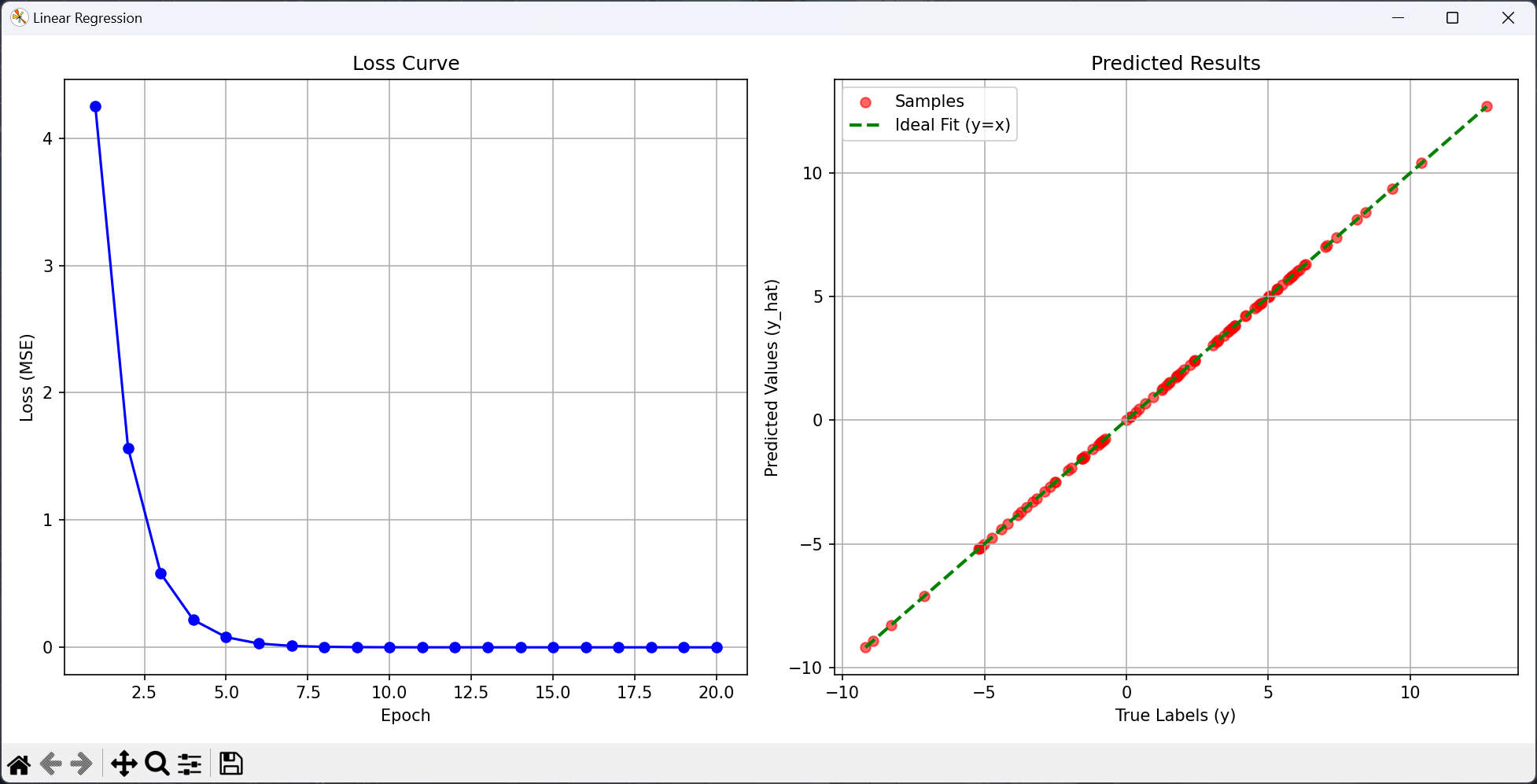
import torchfrom torch import Tensorimport randomfrom matplotlib import pyplot as pltfrom typing import Tuple , Generator, Any def generator (true_w: Tensor, true_b: float , size: int = 2000 ) -> tuple [Tensor, Tensor]: """线性模型加噪声构造数据集""" X = torch.normal(0 , 1 , (size, len (true_w))) y = X @ true_w + true_b y += torch.normal(0 , 0.01 , y.shape) return X, y.reshape(-1 , 1 ) def data_iter (batch_size: int , features: Tensor, labels: Tensor ) -> Generator[Tuple , Any , None ]: """随机读取小批量数据的数据迭代器""" examples = len (features) indices = list (range (examples)) random.shuffle(indices) for i in range (0 , examples, batch_size): batch_indices = torch.tensor(indices[i: min (i + batch_size, examples)]) yield features[batch_indices], labels[batch_indices] def linreg (X: Tensor, w: Tensor, b: Tensor ): """线性回归模型""" return X @ w + b def squared_loss (y_hat: Tensor, y: Tensor ): """均方损失""" return (y_hat - y.reshape(y_hat.shape)) ** 2 / 2 def sgd (params: list [Tensor], lr: float , batch_size: int ): """小批量随机梯度下降""" with torch.no_grad(): for param in params: param -= lr * param.grad / batch_size param.grad.zero_() def train (): """训练模型""" true_w = torch.tensor([1.1 , -4.5 , 1.4 ]) true_b = 1.1919810 features, labels = generator(true_w, true_b) batch_size = 30 lr = 0.008 epochs = 20 net = linreg loss = squared_loss w = torch.normal(0 , 0.01 , size = (3 , 1 ), requires_grad = True ) b = torch.zeros(1 , requires_grad = True ) loss_history = [] for epoch in range (1 , epochs + 1 ): for X, y in data_iter(batch_size, features, labels): l = loss(net(X, w, b), y) l.sum ().backward() sgd([w, b], lr, batch_size) with torch.no_grad(): train_l = loss(net(features, w, b), labels) l = float (train_l.mean()) loss_history.append(l) print (f"epoch {epoch} , loss {l:f} " ) print ("-" * 30 ) print (f"Δw: {true_w - w.reshape(true_w.shape)} " ) print (f"Δb: {true_b - b} " ) plt.figure(figsize = (13 , 6 )) plt.gcf().canvas.manager.set_window_title("Linear Regression" ) plt.subplot(1 , 2 , 1 ) plt.plot(range (1 , epochs + 1 ), loss_history, marker = "o" , color = "b" ) plt.xlabel("Epoch" ) plt.ylabel("Loss (MSE)" ) plt.title("Loss Curve" ) plt.grid(True ) with torch.no_grad(): sample_idx = torch.randperm(len (features))[:100 ] sample_features = features[sample_idx] sample_labels = labels[sample_idx] predictions = net(sample_features, w, b) plt.subplot(1 , 2 , 2 ) plt.scatter(sample_labels.numpy(), predictions.numpy(), alpha = 0.6 , color = "red" , label = "Samples" ) min_val = min (sample_labels.min (), predictions.min ()) max_val = max (sample_labels.max (), predictions.max ()) plt.plot([min_val, max_val], [min_val, max_val], 'g--' , linewidth = 2 , label = "Ideal Fit (y=x)" ) plt.xlabel("True Labels (y)" ) plt.ylabel("Predicted Values (y_hat)" ) plt.title("Predicted Results" ) plt.legend() plt.grid(True ) plt.tight_layout() plt.show() if __name__ == "__main__" : train()
当然也可以用 PyTorch 的高级 API 来实现线性回归,这里就不搓了。
3.3 softmax 回归 softmax 回归用于解决多分类问题,其输出是一个概率分布。(本质是把全连接层的输出序列变成一个概率序列)
为什么不直接叫 softmax 分类呢?
和线性回归一样,softmax 回归也是一个单层神经网络,其输出层也是一个全连接层(fully‐connected layer)。
分类问题模型 数据分类可使用 独热编码 (one-hot encoding)。
我们需要根据输入,给出每个分类的概率。
softmax 运算 我们希望模型的输出
我们无法将线性层的输出向量
其 中
容易验证,
尽管 softmax 是一个非线性函数,但 softmax 回归的输出仍然由输入特征的仿射变换决定,因此,softmax 回归是一个线性模型 (linear model)。
softmax 运算可通过小批量样本的矢量化来加速。设特征维度(输入数列)为
交叉熵损失 分类任务的基石,源于信息论,用于衡量两个概率分布之间的差异。
对于任何标签
特别地,相对于任何未规范化的预测
推导过程先咕了。
3.4 softmax 回归 实现 Fashion-MNIST 分类 就算知道是怎么一回事,实现起来也还是有点难度的。
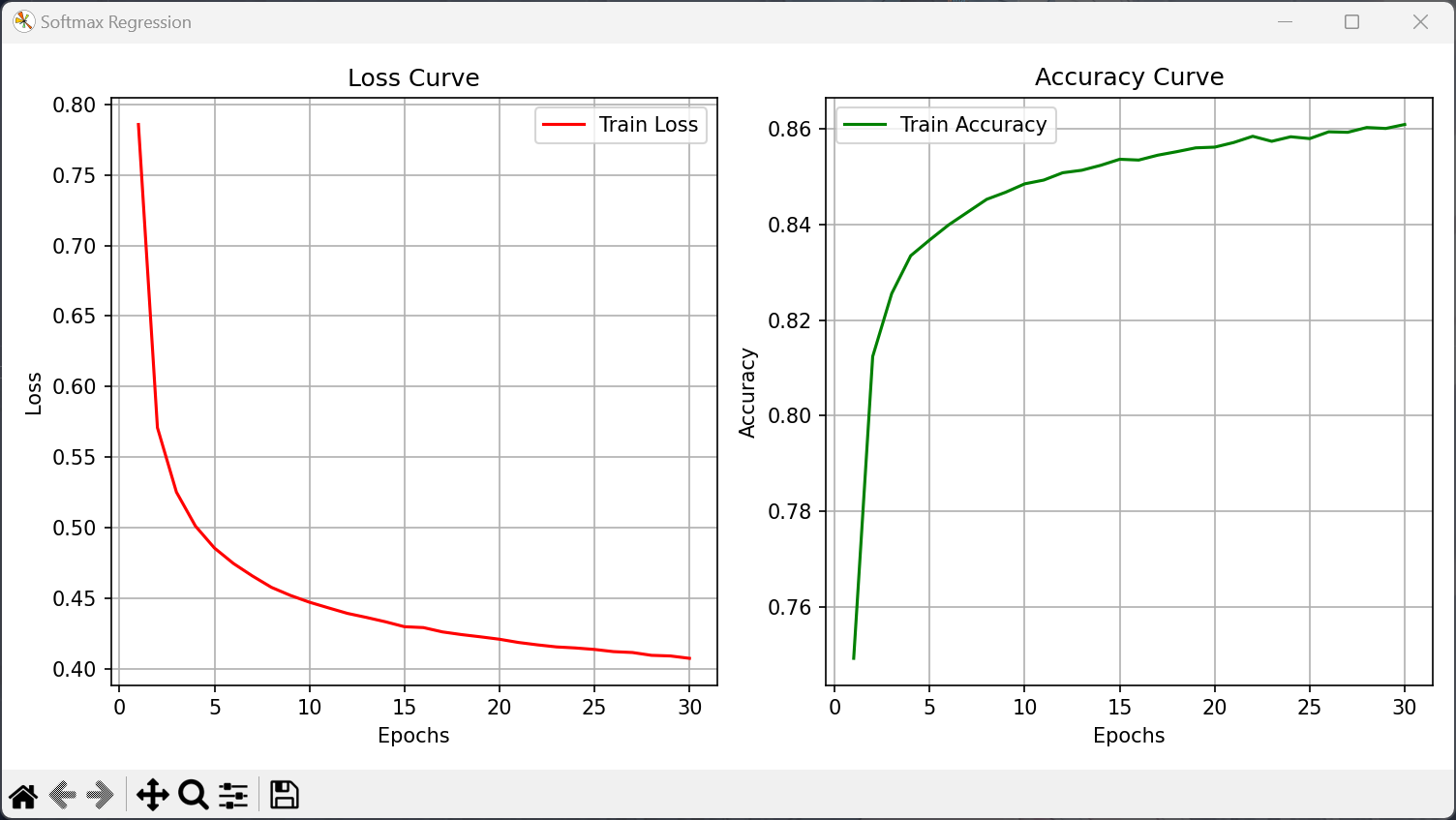
import timeimport torchimport torchvisionfrom torch import Tensorfrom torchvision import transformsfrom matplotlib import pyplot as pltBATCH_SIZE = 256 LEARNING_RATE = 0.1 EPOCHS = 30 DEVICE = torch.device("cuda" if torch.cuda.is_available() else "cpu" ) print (f"Device: {DEVICE} " )print (f"Batch Size: {BATCH_SIZE} " )print (f"Learning Rate: {LEARNING_RATE} " )train_data = torchvision.datasets.FashionMNIST(root = './fashion_mnist' , train = True , transform = transforms.ToTensor(), download = True ) test_data = torchvision.datasets.FashionMNIST(root = './fashion_mnist' , train = False , transform = transforms.ToTensor(), download = True ) train_loader = torch.utils.data.DataLoader(train_data, batch_size = BATCH_SIZE, shuffle = True ) test_loader = torch.utils.data.DataLoader(test_data, batch_size = BATCH_SIZE, shuffle = False ) N_INPUT = 784 N_OUTPUT = 10 W = torch.normal(0 , 0.01 , size = (N_INPUT, N_OUTPUT), device = DEVICE, requires_grad = True ) b = torch.zeros(N_OUTPUT, device = DEVICE, requires_grad = True ) def softmax (X: Tensor ) -> Tensor: """计算 softmax 值""" X_exp = torch.exp(X) partition = X_exp.sum (dim = 1 , keepdim = True ) return X_exp / partition def net (X: Tensor ) -> Tensor: """输入特征 X,返回模型预测输出""" return softmax(X.reshape((-1 , W.shape[0 ])) @ W + b) def cross_entropy (y_hat: Tensor, y: Tensor ) -> Tensor: """交叉熵损失""" return - torch.log(y_hat[range (len (y_hat)), y]) def accuracy (y_hat: Tensor, y: Tensor ) -> float : """计算精度""" if len (y_hat.shape) > 1 and y_hat.shape[1 ] > 1 : y_hat = y_hat.argmax(axis = 1 ) cmp = y_hat.type (y.dtype) == y return float (cmp.type (y.dtype).sum ()) def sgd (params: list [Tensor], lr: float , batch_size: int ): """小批量随机梯度下降""" with torch.no_grad(): for param in params: param -= lr * param.grad / batch_size param.grad.zero_() def train (): """训练模型""" loss_history = [] acc_history = [] print (f"{'=' * 15 } Training Process {'=' * 15 } " ) stime = time.time() for epoch in range (1 , EPOCHS + 1 ): metric = [0.0 , 0.0 , 0.0 ] for X, y in train_loader: X, y = X.to(DEVICE), y.to(DEVICE) y_hat = net(X) l = cross_entropy(y_hat, y) l.sum ().backward() sgd([W, b], LEARNING_RATE, BATCH_SIZE) with torch.no_grad(): metric[0 ] += l.sum ().item() metric[1 ] += accuracy(y_hat, y) metric[2 ] += X.shape[0 ] loss_history.append(metric[0 ] / metric[2 ]) acc_history.append(metric[1 ] / metric[2 ]) print (f"Epoch {epoch} /{EPOCHS} , Loss: {loss_history[-1 ]:.4 f} , Accuracy: {acc_history[-1 ]:.4 f} " ) etime = time.time() print (f"{'=' * 15 } Time Usage: {etime - stime:.0 f} s {'=' * 15 } " ) acc_sum, n = 0.0 , 0 with torch.no_grad(): for X, y in test_loader: X, y = X.to(DEVICE), y.to(DEVICE) acc_sum += accuracy(net(X), y) n += y.numel() print (f"\nTest Accuracy: {acc_sum / n:.4 f} " ) plt.figure(figsize = (10 , 5 )) plt.gcf().canvas.manager.set_window_title("Softmax Regression" ) plt.subplot(1 , 2 , 1 ) plt.plot(range (1 , EPOCHS + 1 ), loss_history, label = "Train Loss" , color = "red" ) plt.xlabel("Epochs" ) plt.ylabel("Loss" ) plt.title("Loss Curve" ) plt.legend() plt.grid(True ) plt.subplot(1 , 2 , 2 ) plt.plot(range (1 , EPOCHS + 1 ), acc_history, label = "Train Accuracy" , color = "green" ) plt.xlabel("Epochs" ) plt.ylabel("Accuracy" ) plt.title("Accuracy Curve" ) plt.legend() plt.grid(True ) plt.tight_layout() plt.show() if __name__ == "__main__" : train()
训练输出:
Device: cuda
Batch Size: 256
Learning Rate: 0.1
=============== Training Process ===============
Epoch 1/30, Loss: 0.7859, Accuracy: 0.7493
...
Epoch 30/30, Loss: 0.4072, Accuracy: 0.8609
=============== Time Usage: 145s ===============

Test Accuracy: 0.8417
4. 多层感知机 线性模型假设特征与输出之间存在线性关系 ,这种假设在许多实际问题中是不成立的。
为了处理更普遍的函数关系类型,我们需要非线性变换,这可以通过堆层、引入非线性激活函数等来实现。
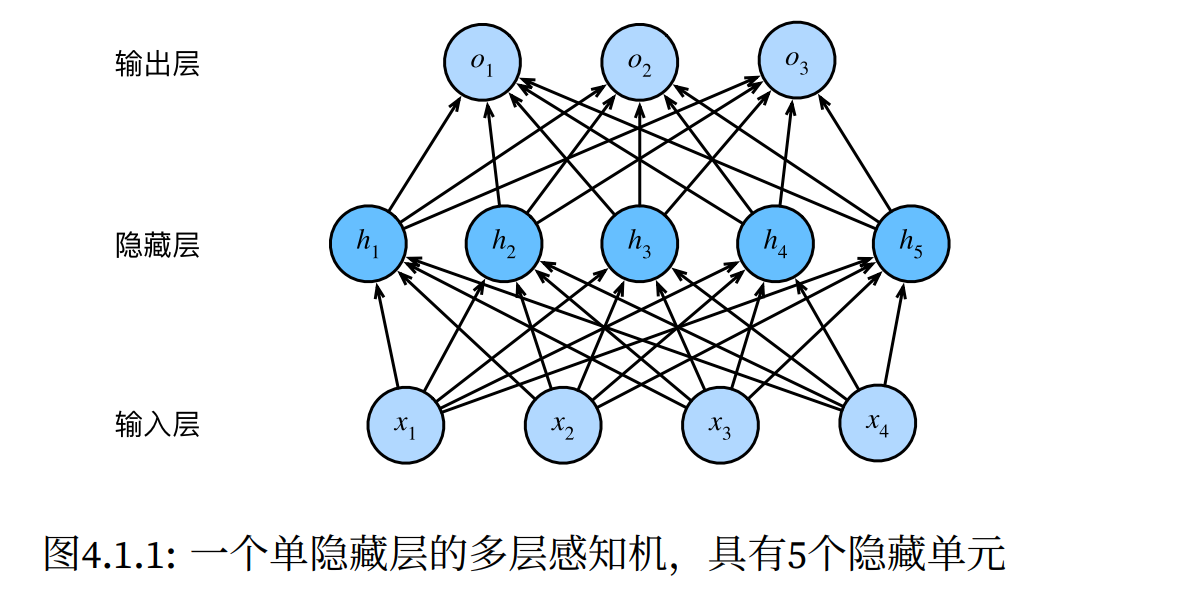
4.1 隐藏层 在输入层与输出层之间的层,称为隐藏层 (hidden layer)。
我们可以通过在网络中加入一个或多个隐藏层来克服线性模型的限制,使其能处理更普遍的函数关系类型。
要做到这一点,最简单的方法是将许多全连接层堆叠在一起。每一层都输出到上面的层,直到生成最后的输出。我们可以把前多层感知机 (Multilayer Perceptron, MLP)。
如下如所示(图片截自 D2L):
不过,具有全连接层的多层感知机的参数开销可能会爆炸,需要合理地设置隐藏层的大小。
4.2 激活函数 隐藏单元由输入的仿射函数给出,输出只是隐藏单元的仿射函数。仿射函数的仿射函数本身就是仿射函数,而之前的线性模型已经能够表示任何仿射函数。
为了防止多层感知机退化成线性模型,需要引入非线性的激活函数 。
常见的激活函数有 Sigmoid 、tanh 、ReLU 、Leaky ReLU 等,这里就不一一展开介绍了。
4.3 实现 MLP 这里做一个双隐藏层的简单 MLP,激活函数用 ReLU。
只要在之前的 softmax 回归的代码基础上稍作修改即可。
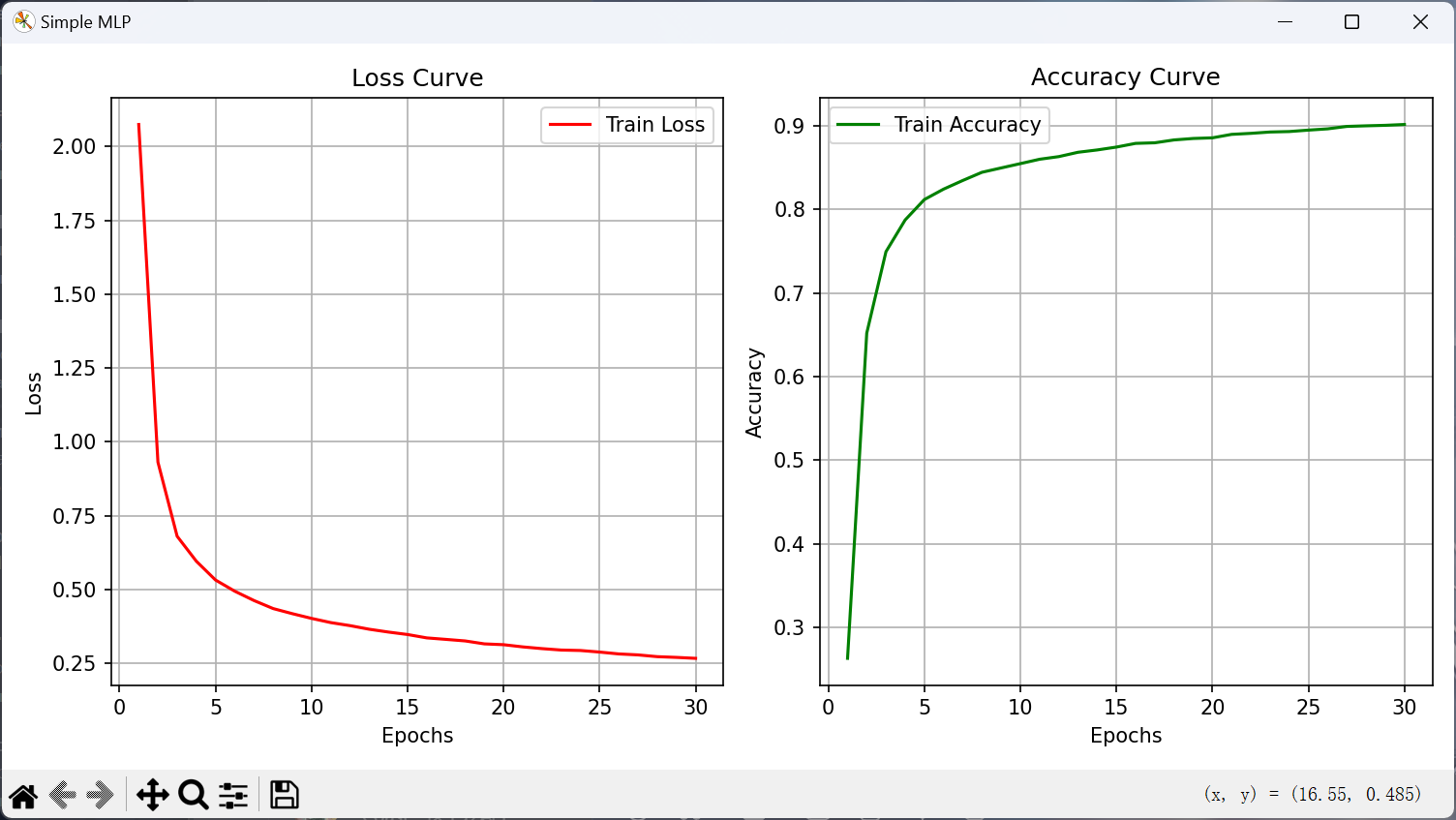
import timeimport torchimport torchvisionfrom torch import Tensorfrom torchvision import transformsfrom matplotlib import pyplot as pltBATCH_SIZE = 256 LEARNING_RATE = 0.1 EPOCHS = 30 DEVICE = torch.device("cuda" if torch.cuda.is_available() else "cpu" ) print (f"Device: {DEVICE} " )print (f"Batch Size: {BATCH_SIZE} " )print (f"Learning Rate: {LEARNING_RATE} " )train_data = torchvision.datasets.FashionMNIST(root = './fashion_mnist' , train = True , transform = transforms.ToTensor(), download = True ) test_data = torchvision.datasets.FashionMNIST(root = './fashion_mnist' , train = False , transform = transforms.ToTensor(), download = True ) train_loader = torch.utils.data.DataLoader(train_data, batch_size = BATCH_SIZE, shuffle = True ) test_loader = torch.utils.data.DataLoader(test_data, batch_size = BATCH_SIZE, shuffle = False ) N_INPUT = 784 N_HIDDEN_1 = 256 N_HIDDEN_2 = 128 N_OUTPUT = 10 W1 = torch.normal(0 , 0.01 , size = (N_INPUT, N_HIDDEN_1), device = DEVICE, requires_grad = True ) b1 = torch.zeros(N_HIDDEN_1, device = DEVICE, requires_grad = True ) W2 = torch.normal(0 , 0.01 , size = (N_HIDDEN_1, N_HIDDEN_2), device = DEVICE, requires_grad = True ) b2 = torch.zeros(N_HIDDEN_2, device = DEVICE, requires_grad = True ) W3 = torch.normal(0 , 0.01 , size = (N_HIDDEN_2, N_OUTPUT), device = DEVICE, requires_grad = True ) b3 = torch.zeros(N_OUTPUT, device = DEVICE, requires_grad = True ) params = [W1, b1, W2, b2, W3, b3] def relu (X: Tensor ) -> Tensor: a = torch.zeros_like(X) return torch.max (X, a) def softmax (X: Tensor ) -> Tensor: """计算 softmax 值""" X_exp = torch.exp(X) partition = X_exp.sum (dim = 1 , keepdim = True ) return X_exp / partition def net (X: Tensor ) -> Tensor: """输入特征 X,经过两层隐藏层后返回预测输出""" X = X.reshape((-1 , N_INPUT)) H1 = relu(X @ W1 + b1) H2 = relu(H1 @ W2 + b2) return softmax(H2 @ W3 + b3) def cross_entropy (y_hat: Tensor, y: Tensor ) -> Tensor: """交叉熵损失""" return - torch.log(y_hat[range (len (y_hat)), y]) def accuracy (y_hat: Tensor, y: Tensor ) -> float : """计算精度""" if len (y_hat.shape) > 1 and y_hat.shape[1 ] > 1 : y_hat = y_hat.argmax(axis = 1 ) cmp = y_hat.type (y.dtype) == y return float (cmp.type (y.dtype).sum ()) def sgd (params: list [Tensor], lr: float , batch_size: int ): """小批量随机梯度下降""" with torch.no_grad(): for param in params: param -= lr * param.grad / batch_size param.grad.zero_() def train (): """训练模型""" loss_history = [] acc_history = [] print (f"{'=' * 15 } Training Process {'=' * 15 } " ) stime = time.time() for epoch in range (1 , EPOCHS + 1 ): metric = [0.0 , 0.0 , 0.0 ] for X, y in train_loader: X, y = X.to(DEVICE), y.to(DEVICE) y_hat = net(X) l = cross_entropy(y_hat, y) l.sum ().backward() sgd(params, LEARNING_RATE, BATCH_SIZE) with torch.no_grad(): metric[0 ] += l.sum ().item() metric[1 ] += accuracy(y_hat, y) metric[2 ] += X.shape[0 ] loss_history.append(metric[0 ] / metric[2 ]) acc_history.append(metric[1 ] / metric[2 ]) print (f"Epoch {epoch} /{EPOCHS} , Loss: {loss_history[-1 ]:.4 f} , Accuracy: {acc_history[-1 ]:.4 f} " ) etime = time.time() print (f"{'=' * 15 } Time Usage: {etime - stime:.0 f} s {'=' * 15 } " ) acc_sum, n = 0.0 , 0 with torch.no_grad(): for X, y in test_loader: X, y = X.to(DEVICE), y.to(DEVICE) acc_sum += accuracy(net(X), y) n += y.numel() print (f"\nTest Accuracy: {acc_sum / n:.4 f} " ) plt.figure(figsize = (10 , 5 )) plt.gcf().canvas.manager.set_window_title("Simple MLP" ) plt.subplot(1 , 2 , 1 ) plt.plot(range (1 , EPOCHS + 1 ), loss_history, label = "Train Loss" , color = "red" ) plt.xlabel("Epochs" ) plt.ylabel("Loss" ) plt.title("Loss Curve" ) plt.legend() plt.grid(True ) plt.subplot(1 , 2 , 2 ) plt.plot(range (1 , EPOCHS + 1 ), acc_history, label = "Train Accuracy" , color = "green" ) plt.xlabel("Epochs" ) plt.ylabel("Accuracy" ) plt.title("Accuracy Curve" ) plt.legend() plt.grid(True ) plt.tight_layout() plt.show() if __name__ == "__main__" : train()
训练输出:
Device: cuda
Batch Size: 256
Learning Rate: 0.1
=============== Training Process ===============
Epoch 1/30, Loss: 2.0744, Accuracy: 0.2627
...
Epoch 30/30, Loss: 0.2668, Accuracy: 0.9015
=============== Time Usage: 156s ===============

Test Accuracy: 0.8786
表现略好于之前的 softmax 回归。
4.4 咕咕本章其它部分 此后,该书插入讲解了模型选择、欠拟合和过拟合、正则化、权重衰减、Dropout等内容,这些内容比较零碎,感觉没必要特地记录,故先略过。
5. 深度学习计算 5.1 层和块 为了实现复杂的网络,需引入神经网络块的概念。块 (block) 可以描述单个层、由多个层组成的组件或整个模型本身。使用块进行抽象的一个好处就是组合方便、代码实现简洁。
很自然地,在代码编写中,可以用类来表示块。这个类的任何子类需要包含:
任何必需的参数 (parameters); 将输入转为输出的前向传播函数 (forward); 用于计算梯度的反向传播函数 (backward)。 在定义我们自己的块时,由于自动微分 提供了一些后端实现,我们只需要考虑前向传播函数和必需的参数。
5.2 重构 MLP 现在,应用层和块的思想,并使用 PyTorch 的高级 API 来重构原来的丑陋 MPL。
具体来说:
使用 torch.optim.AdamW 优化器替换 sgd 函数。 使用 nn.Sequential 替换 net 函数。 使用 nn.Linear 层自动管理权重 W 和偏置 b。 使用 nn.CrossEntropyLoss 来计算交叉熵损失。 使用 model.train() 与 model.eval() 来切换训练和测试模式。 比原来优雅多了。
import timeimport torchimport torchvisionfrom torch import Tensorfrom torch import nnfrom torchvision import transformsfrom matplotlib import pyplot as pltBATCH_SIZE = 256 LEARNING_RATE = 0.001 EPOCHS = 30 DEVICE = torch.device("cuda" if torch.cuda.is_available() else "cpu" ) print (f"Device: {DEVICE} " )print (f"Batch Size: {BATCH_SIZE} " )print (f"Learning Rate: {LEARNING_RATE} " )train_data = torchvision.datasets.FashionMNIST(root = './fashion_mnist' , train = True , transform = transforms.ToTensor(), download = True ) test_data = torchvision.datasets.FashionMNIST(root = './fashion_mnist' , train = False , transform = transforms.ToTensor(), download = True ) train_loader = torch.utils.data.DataLoader(train_data, batch_size = BATCH_SIZE, shuffle = True ) test_loader = torch.utils.data.DataLoader(test_data, batch_size = BATCH_SIZE, shuffle = False ) class MLP (nn.Module): def __init__ (self, input_size, hidden_1, hidden_2, output_size ): super (MLP, self ).__init__() self .net = nn.Sequential( nn.Flatten(), nn.Linear(input_size, hidden_1), nn.ReLU(), nn.Linear(hidden_1, hidden_2), nn.ReLU(), nn.Linear(hidden_2, output_size) ) def forward (self, x ): return self .net(x) N_INPUT = 784 N_HIDDEN_1 = 256 N_HIDDEN_2 = 128 N_OUTPUT = 10 model = MLP(N_INPUT, N_HIDDEN_1, N_HIDDEN_2, N_OUTPUT).to(DEVICE) loss_fn = nn.CrossEntropyLoss() optimizer = torch.optim.AdamW(model.parameters(), lr = LEARNING_RATE) def accuracy (y_hat: Tensor, y: Tensor ) -> float : """计算精度""" pred = y_hat.argmax(dim = 1 ) correct = (pred == y).sum ().item() return correct def evaluate (model, data_loader ): """在测试集上评估模型""" model.eval () acc_sum, n = 0.0 , 0 with torch.no_grad(): for X, y in data_loader: X, y = X.to(DEVICE), y.to(DEVICE) y_hat = model(X) acc_sum += accuracy(y_hat, y) n += y.size(0 ) return acc_sum / n def train (): """训练模型""" loss_history = [] acc_history = [] print (f"{'=' * 15 } Training Process {'=' * 15 } " ) stime = time.time() for epoch in range (1 , EPOCHS + 1 ): model.train() loss_sum = 0.0 correct_sum = 0 tot = 0 for X, y in train_loader: X, y = X.to(DEVICE), y.to(DEVICE) y_hat = model(X) loss = loss_fn(y_hat, y) optimizer.zero_grad() loss.backward() optimizer.step() batch_size = y.size(0 ) loss_sum += loss.item() * batch_size correct_sum += accuracy(y_hat, y) tot += batch_size loss_history.append(loss_sum / tot) acc_history.append(correct_sum / tot) print (f"Epoch {epoch} /{EPOCHS} , Loss: {loss_history[-1 ]:.4 f} , Accuracy: {acc_history[-1 ]:.4 f} " ) test_acc = evaluate(model, test_loader) print (f"\nTest Accuracy: {test_acc:.4 f} " ) plt.figure(figsize = (10 , 5 )) plt.gcf().canvas.manager.set_window_title("Simple MLP" ) plt.subplot(1 , 2 , 1 ) plt.plot(range (1 , EPOCHS + 1 ), loss_history, label = "Train Loss" , color = "red" ) plt.xlabel("Epochs" ) plt.ylabel("Loss" ) plt.title("Loss Curve" ) plt.legend() plt.grid(True ) plt.subplot(1 , 2 , 2 ) plt.plot(range (1 , EPOCHS + 1 ), acc_history, label = "Train Accuracy" , color = "green" ) plt.xlabel("Epochs" ) plt.ylabel("Accuracy" ) plt.title("Accuracy Curve" ) plt.legend() plt.grid(True ) plt.tight_layout() plt.show() if __name__ == "__main__" : train()
5.3 save & load SL Tensor 令 x : Tensor。
Save 调用 torch.save。
Load 调用 torch.load。
SL Model 令 model : nn.Module。
Save 一般来说,我们只需要保存模型的参数,而不需要保存模型的结构。
调用 model.state_dict() 得到模型参数字典。 调用 torch.save 保存参数字典。 torch.save(model.state_dict(), "model.params" )
Load 调用 model.load_state_dict。
model = Model() model.load_state_dict(torch.load("model.params" ))
SL Optimizer 令 optimizer : torch.optim.Optimizer。
Save 一般来说,我们只需要保存优化器的参数,而不需要保存优化器的结构。
调用 optimizer.state_dict() 得到优化器参数字典。 调用 torch.save 保存参数字典。 torch.save(optimizer.state_dict(), "optimizer.params" )
Load 调用 optimizer.load_state_dict。
optimizer = Optimizer() optimizer.load_state_dict(torch.load("optimizer.params" ))
5.4 咕咕本章其它部分 该书还介绍了参数管理、延后初始化、自定义层、设置计算设备等不太需要记录的内容,直接略过。
6. 卷积神经网络 多层感知机无法处理高维感知数据。全连接层的参数量会爆炸,且隐藏层不足以学习到良好的特征。
卷积神经网络(Convolutional Neural Networks,CNN)是解决这种问题的一种创造性方法。
6.1 从全连接到卷积 卷积层 设多层感知机的输入为二维图像
其 中
简单来说,就是可以直接用偏移
考虑以下两个有用的性质:
平移不变性 (translation invariance):不管检测对象出现在输入的哪个位置,神经网络的前几层应该对相同的区域有相似的反应。这意味着检测对象在输入
局部性 (locality):神经网络的每一层都应该只学习到局部特征,而不过度在意相隔较远区域的信息,最后再通过聚合局部特征预测整体特征。这意味着隐藏表示
由平移不变性,
这个式子就是互相关运算 (cross‐correlation).
再考虑局部性,我们不应过度考虑偏离
上式即为一个卷积层 (convolutional layer),其中卷积核 (convolution kernel)或滤波器 (filter)。
相比全连接层,卷积层极大减少了参数量,需要注意的是,仅当输入具有平移不变性时,才能使用卷积表示!
通道 上面提到的卷积层的输入是二维图像,但实际应用中,图像一般包含了三个通道(三种原色,如 RGB)。因此图像实际上是三维张量,除了前面的两个空间维度外,还要加一个表示颜色的轴。
由于输入图像是三维的,卷积相应地调整为
隐藏表示
为了支持
其中隐藏表示
输出大小计算 设输入形状为填充 (padding)为步幅 (stride)为
如果设置
如果输入的高度和宽度分别可被垂直步幅和水平步幅整除,则输出大小就是
显然,填充可以增加输出的大小,步幅会减少输出的大小。利用二者可以有效调整数据维度。
多输入通道 卷积核通道数应与输入相同。若输入通道数为
多输出通道 直观地说,我们可以将每个通道看作对不同特征的响应。而现实可能更为复杂一些,因为每个通道不是独立学习的,而是为了共同使用而优化的。因此,多输出通道并不仅是学习多个单通道的检测器。
在互相关运算中,每个输出通道先获取所有输入通道,再以对应该输出通道的卷积核计算出结果。
流程就是:
输入有 对于某个输出通道它有 每组核与输入的一个通道做互相关 把 得到一个输出通道 设输入和输出通道数分别为
显然,
通过
6.2 池化层(pooling layer) 书上采用的名字是汇聚层,但我个人更喜欢池化这个名字,因此这里都用池化层。
池化的目的:降低卷积层对位置的敏感性,同时降低对空间降采样表示的敏感性。
和卷积运算类似,池化运算也是用一个滑动窗口遍历每个位置计算输出。池化不需要参数,只是提取窗口中所有元素的最大值 或平均值 ,分别称为最大池化 (maximum pooling)和平均池化 (average pooling)。
池化窗口为
和卷积层类似,池化层也可以设置填充和步幅,进而改变输出形状。计算方式同卷积层 。
多通道 和卷积层不同,处理多通道输入时,池化层在每个输入通道上单独运算,因此输出通道数和输入通道数相同。
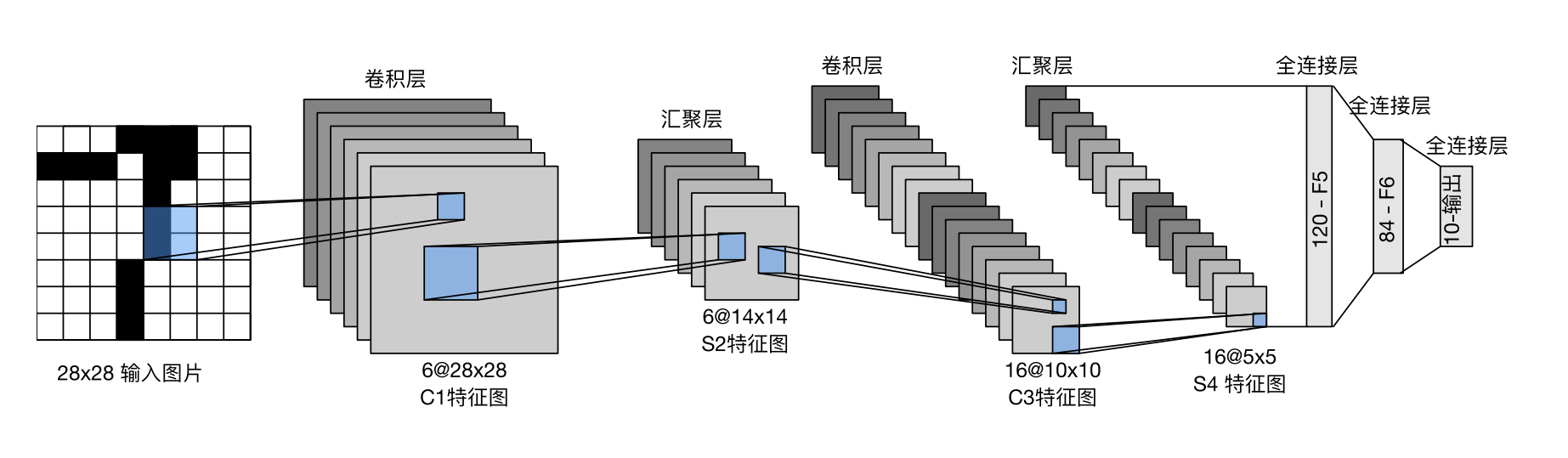
6.3 LeNet-5 现代卷积神经网络的奠基之作。正是其首次引入卷积层和池化层这两个核心组件,构建了现代 CNN 的基本结构范式。
总体来看,LeNet(LeNet‐5)由两个部分组成:
卷积编码器:由两个卷积块构成。 全连接层密集块:由三个全连接层构成。 其结构图如下图所示(D2L 图6.6.1):
接下来准备做代码复现,不过这里的实现和原来的模型略有不同:
激活函数使用 ReLU,而不是 sigmoid 或 tanh。 LeNet-5 的标准输入为transfrom 里加一个 Resize((32, 32))。 transform = transforms.Compose([ transforms.Resize((32 , 32 )), transforms.ToTensor(), ]) train_data = torchvision.datasets.MNIST(root = './mnist' , train = True , transform = transform, download = True ) test_data = torchvision.datasets.MNIST(root = './mnist' , train = False , transform = transform, download = True ) train_loader = torch.utils.data.DataLoader(train_data, batch_size = BATCH_SIZE, shuffle = True ) test_loader = torch.utils.data.DataLoader(test_data, batch_size = BATCH_SIZE, shuffle = False ) class LeNet5 (nn.Module): def __init__ (self ): super (LeNet5, self ).__init__() self .get_feature = nn.Sequential( nn.Conv2d(in_channels = 1 , out_channels = 6 , kernel_size = 5 ), nn.ReLU(), nn.AvgPool2d(kernel_size = 2 , stride = 2 ), nn.Conv2d(in_channels = 6 , out_channels = 16 , kernel_size = 5 ), nn.ReLU(), nn.AvgPool2d(kernel_size = 2 , stride = 2 ) ) self .classify = nn.Sequential( nn.Flatten(), nn.Linear(in_features = 16 * 5 * 5 , out_features = 120 ), nn.ReLU(), nn.Linear(in_features = 120 , out_features = 84 ), nn.ReLU(), nn.Linear(in_features = 84 , out_features = 10 ) ) def forward (self, x ): x = self .get_feature(x) x = self .classify(x) return x model = LeNet5().to(DEVICE)
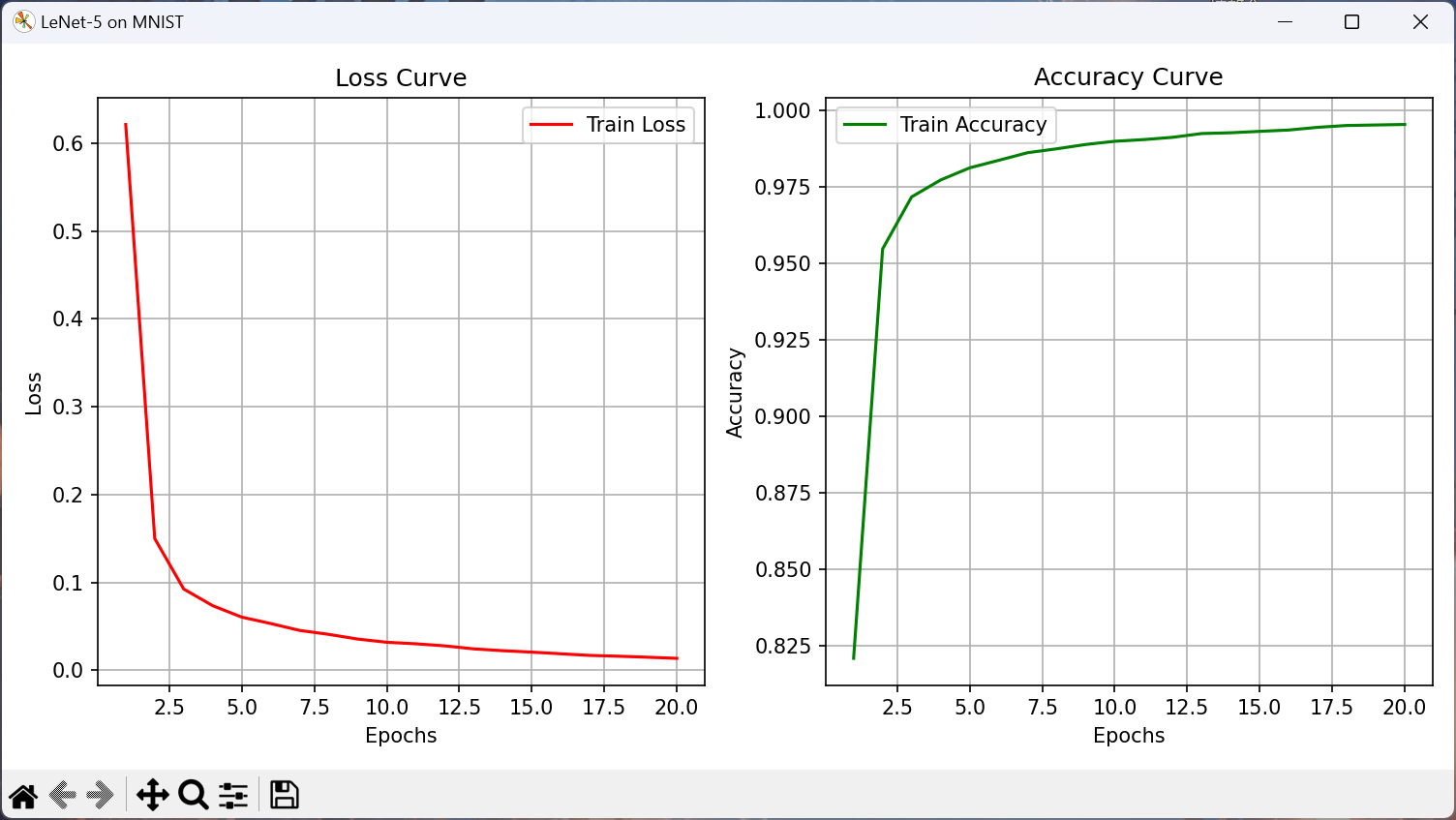
训练输出:
Device: cuda
Batch Size: 256
Learning Rate: 0.001
=============== Training Process ===============
Epoch 1/20 | Loss: 0.6215 | Train Acc: 0.8208
Epoch 2/20 | Loss: 0.1499 | Train Acc: 0.9547
Epoch 3/20 | Loss: 0.0924 | Train Acc: 0.9718
Epoch 4/20 | Loss: 0.0734 | Train Acc: 0.9773
Epoch 5/20 | Loss: 0.0604 | Train Acc: 0.9813
Epoch 6/20 | Loss: 0.0530 | Train Acc: 0.9838
Epoch 7/20 | Loss: 0.0452 | Train Acc: 0.9862
Epoch 8/20 | Loss: 0.0407 | Train Acc: 0.9875
Epoch 9/20 | Loss: 0.0354 | Train Acc: 0.9889
Epoch 10/20 | Loss: 0.0317 | Train Acc: 0.9900
Epoch 11/20 | Loss: 0.0300 | Train Acc: 0.9905
Epoch 12/20 | Loss: 0.0276 | Train Acc: 0.9913
Epoch 13/20 | Loss: 0.0242 | Train Acc: 0.9925
Epoch 14/20 | Loss: 0.0221 | Train Acc: 0.9928
Epoch 15/20 | Loss: 0.0205 | Train Acc: 0.9932
Epoch 16/20 | Loss: 0.0186 | Train Acc: 0.9937
Epoch 17/20 | Loss: 0.0168 | Train Acc: 0.9946
Epoch 18/20 | Loss: 0.0159 | Train Acc: 0.9951
Epoch 19/20 | Loss: 0.0147 | Train Acc: 0.9953
Epoch 20/20 | Loss: 0.0134 | Train Acc: 0.9955
=============== Time Usage: 138s ===============
Test Accuracy: 0.9904
非常强大。
7. 现代卷积神经网络 书上介绍的网络有 AlexNet、VGG、NiN、GoogLeNet、ResNet、DenseNet,这里不按书上的来。
7.1 VGG 见 VGG网络 学习笔记 。
7.2 GoogLeNet 见 GoogLeNet 学习笔记 。
7.3 Batch Normalization 咕咕咕
7.4 ResNet 见 ResNet 学习笔记 。
7.5 MobileNet 咕咕咕
7.6 R-CNN 咕咕咕